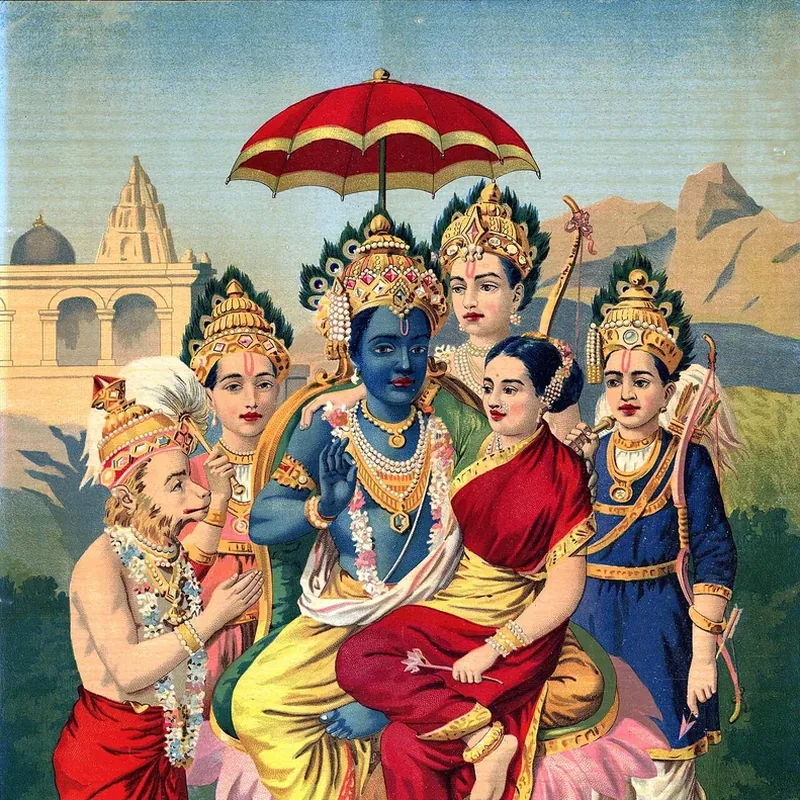
॥ શ્રી રામાય નમઃ ॥
Shri Ramaya Namah
Sundarkand — Mangalacharan
By Tulsidas
संस्कृत · 16th century · Bhajan
~1 min readRama bhakti
The invocatory verses that open the Sundarkand of Tulsidas's Ramcharitmanas. Sundarkand narrates Hanuman's journey to Lanka and his meeting with Sita. The only book of the epic whose events are almost entirely triumphant.
- Author
- Tulsidas
- Language
- संस्कृत
- Literary form
- Bhajan
- Century
- 16th century
- Tradition
- Rama bhakti
Voice Lab
Recite in My Voice
Record yourself reciting or singing this work once. Stored only on this device, never uploaded. The player will use your recording instead of the synthetic chant whenever you tap play.
शान्तं शाश्वतमप्रमेयमनघं निर्वाणशान्तिप्रदं। ब्रह्माशम्भुफणीन्द्रसेव्यमनिशं वेदान्तवेद्यं विभुम्॥ रामाख्यं जगदीश्वरं सुरगुरुं मायामनुष्यं हरिं। वन्देऽहं करुणाकरं रघुवरं भूपालचूड़ामणिम्॥
Meaning
I bow to the peaceful, eternal, immeasurable, sinless, bestower of nirvanic peace; ever served by Brahma, Shiva, and Shesha; knowable through Vedanta; the all-pervading Lord. Named Ram, Lord of the world, teacher of the gods, Hari taking human form by his own maya — the ocean of compassion, best of the Raghus, the crown-jewel of kings.
Devotional companion
About
The invocatory verses that open the Sundarkand of Tulsidas's Ramcharitmanas. Sundarkand narrates Hanuman's journey to Lanka and his meeting with Sita. The only book of the epic whose events are almost entirely triumphant.
Meaning
The auspicious opening of the Ramayana's most beloved chapter — Hanuman's leap to Lanka.
In depth
I bow to the peaceful, eternal, immeasurable, sinless, bestower of nirvanic peace; ever served by Brahma, Shiva, and Shesha; knowable through Vedanta; the all-pervading Lord. Named Ram, Lord of the world, teacher of the gods, Hari taking human form by his own maya — the ocean of compassion, best of the Raghus, the crown-jewel of kings.
History & context
Opening mangalacharan (invocation) of Sundarkand, the fifth book of Tulsidas's Ramcharitmanas. Recited at the start of weekly Sundarkand path.
Why people recite it
A complete Sundarkand recital (paath) is held for the fulfilment of wishes, for removing obstacles, and as a weekly devotional practice in many families, especially on Tuesdays and Saturdays.
Life lessons
- The widest gulf can be crossed by one who acts with faith and a clear purpose. Hanuman's leap is the courage to begin before the path is proven.
Key themes
TulsidasSundarkandRamayanaRamcharitmanasShivaSurrenderName ChantingDevotion
About the author
Goswami Tulsidas
गोस्वामी तुलसीदास
- Era
- c. 1497–1623 CE (traditional)
- Region
- Awadh and Kashi (Varanasi)
- Tradition
- Rama bhakti
Goswami Tulsidas was a North Indian poet-saint who wrote in Awadhi and Braj, and is revered above all as the author of the Ramcharitmanas — a retelling of the Ramayana in the language of the common people. By placing the story of Rama in the vernacular rather than Sanskrit, he made the epic singable in homes, fields and temple courtyards across the Hindi-speaking world.
Tradition holds that he was a devotee of Hanuman, and several short works of praise to Hanuman are attributed to his tradition. His poetry binds together intense personal devotion (bhakti), ethical conduct, and the ideal of Rama-rajya — a just and compassionate order. To this day his verses are recited at dawn, during Ramnavami, and in the daily worship of millions.
Precise dates and biographical details are debated by scholars; the year 1497 and a long life reaching 1623 are the traditional account rather than firmly documented fact.
Notable works
RamcharitmanasVinaya PatrikaKavitavaliDohavali
Dates and several biographical episodes are traditional accounts, not firmly documented history.
You may also like

Chalisaहिन्दी
Hanuman Chalisa
Tulsidas · 16th century
A 40-verse hymn to Hanuman — courage, strength and unwavering devotion, recited daily across India.
Read & recite →
Stotraसंस्कृत
Ram Raksha Stotra — Opening
Budha-Kausika Rishi · Ancient
A 'shield of Rama' — a protective Sanskrit hymn invoking Rama's guard over every part of the body.
Read & recite →
Stutiहिन्दी
Shri Ramchandra Kripalu
Tulsidas · 16th century
O mind, sing of merciful Shri Ramchandra, dispeller of the dreadful fears of worldly existence.
Read & recite →
Bhajanहिन्दी
Thumak Chalat Ramchandra
Tulsidas · 16th century
Tulsidas's tender vision of the child Rama learning to walk.
Read & recite →
Bhajanहिन्दी
Raghupati Raghav Raja Ram
Traditional (popularised by Mahatma Gandhi) · Traditional
Lord of the Raghu clan, King Ram, redeemer of the fallen, Sita-Ram.
Read & recite →
Mantraहिन्दी
Shri Ram Jay Ram (Taraka Mantra)
Traditional · Traditional
The thirteen-syllable Ram-dhun chanted to cross worldly life.
Read & recite →
Source & trust
Public domain
- Attribution
- Tulsidas
- Language
- संस्कृत · 16th century
- Source
- Public domain — Tulsidas, Ramcharitmanas, 16th century.
Devotional commentary and life lessons are editorial reflections. Historical details are limited to well-documented facts; devotional belief is labelled as tradition, never presented as proven history.