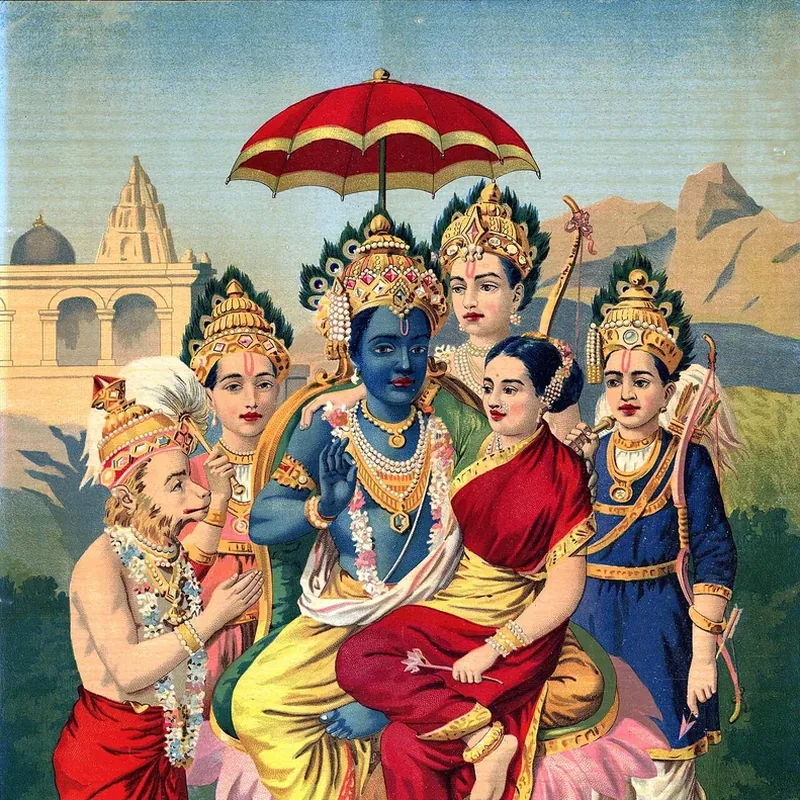
RamAncient
श्रीरामरक्षास्तोत्रम् (प्रारम्भ)
Ram Raksha Stotra — Opening
By Budha-Kausika Rishi · संस्कृत
॥ શ્રી રામાય નમઃ ॥
Shri Ramaya Namah
श्रीरामरक्षास्तोत्रम् (प्रारम्भ)
Ram Raksha Stotra — Opening
By Budha-Kausika Rishi
संस्कृत · Ancient · Stotra
~1 min readRama bhakti
A kavach-style stotra that asks Rama to protect the devotee limb by limb. Attributed to the sage Budha Kaushika, received (by tradition) in a dream. Recited at night and before journeys as a prayer for safety.
- Author
- Budha-Kausika Rishi
- Language
- संस्कृत
- Literary form
- Stotra
- Century
- Ancient
- Tradition
- Rama bhakti
Voice Lab
Recite in My Voice
Record yourself reciting or singing this work once. Stored only on this device, never uploaded. The player will use your recording instead of the synthetic chant whenever you tap play.
ॐ अस्य श्रीरामरक्षास्तोत्रमन्त्रस्य बुधकौशिक ऋषिः। श्रीसीतारामचन्द्रो देवता। अनुष्टुप् छन्दः। सीता शक्तिः। श्रीमद्हनुमान कीलकम्। श्रीरामचन्द्र प्रीत्यर्थे जपे विनियोगः॥
चरितं रघुनाथस्य शतकोटिप्रविस्तरम्। एकैकमक्षरं पुंसां महापातकनाशनम्॥
Meaning
The seer of this Ram Raksha mantra is Budha-Kaushika; the deity is Sri Sita-Ramachandra; the meter is Anushtup; Sita is the energy; Hanuman is the support. It is recited for the pleasure of Sri Ramachandra. The story of Raghunath extends to a hundred crore verses; even one of its syllables destroys the greatest sins.
Devotional companion
About
A kavach-style stotra that asks Rama to protect the devotee limb by limb. Attributed to the sage Budha Kaushika, received (by tradition) in a dream. Recited at night and before journeys as a prayer for safety.
Meaning
A 'shield of Rama' — a protective Sanskrit hymn invoking Rama's guard over every part of the body.
In depth
The seer of this Ram Raksha mantra is Budha-Kaushika; the deity is Sri Sita-Ramachandra; the meter is Anushtup; Sita is the energy; Hanuman is the support. It is recited for the pleasure of Sri Ramachandra. The story of Raghunath extends to a hundred crore verses; even one of its syllables destroys the greatest sins.
History & context
The Ram Raksha Stotra is traditionally attributed to the sage Budha Kaushika. It belongs to the 'kavach' (armour) genre of Sanskrit hymns that map divine protection onto the body, a form especially beloved in Maharashtra and the north.
Why people recite it
Recited for protection — before travel, at bedtime, or during uncertain times — and as a daily affirmation of being held safe within Rama's name.
Life lessons
- True security is not the absence of danger but the presence of trust. The hymn trades anxiety for a felt sense of being guarded.
Key themes
RamaRakshaStotraProtectionSurrenderName ChantingDevotion
You may also like

Chalisaहिन्दी
Hanuman Chalisa
Tulsidas · 16th century
A 40-verse hymn to Hanuman — courage, strength and unwavering devotion, recited daily across India.
Read & recite →
Bhajanसंस्कृत
Sundarkand — Mangalacharan
Tulsidas · 16th century
The auspicious opening of the Ramayana's most beloved chapter — Hanuman's leap to Lanka.
Read & recite →
Stutiहिन्दी
Shri Ramchandra Kripalu
Tulsidas · 16th century
O mind, sing of merciful Shri Ramchandra, dispeller of the dreadful fears of worldly existence.
Read & recite →
Bhajanहिन्दी
Raghupati Raghav Raja Ram
Traditional (popularised by Mahatma Gandhi) · Traditional
Lord of the Raghu clan, King Ram, redeemer of the fallen, Sita-Ram.
Read & recite →
Bhajanहिन्दी
Thumak Chalat Ramchandra
Tulsidas · 16th century
Tulsidas's tender vision of the child Rama learning to walk.
Read & recite →
Mantraहिन्दी
Shri Ram Jay Ram (Taraka Mantra)
Traditional · Traditional
The thirteen-syllable Ram-dhun chanted to cross worldly life.
Read & recite →
Source & trust
Public domain
- Attribution
- Budha-Kausika Rishi
- Language
- संस्कृत · Ancient
- Source
- Public domain — Budha-Kaushika (ancient).
Devotional commentary and life lessons are editorial reflections. Historical details are limited to well-documented facts; devotional belief is labelled as tradition, never presented as proven history.