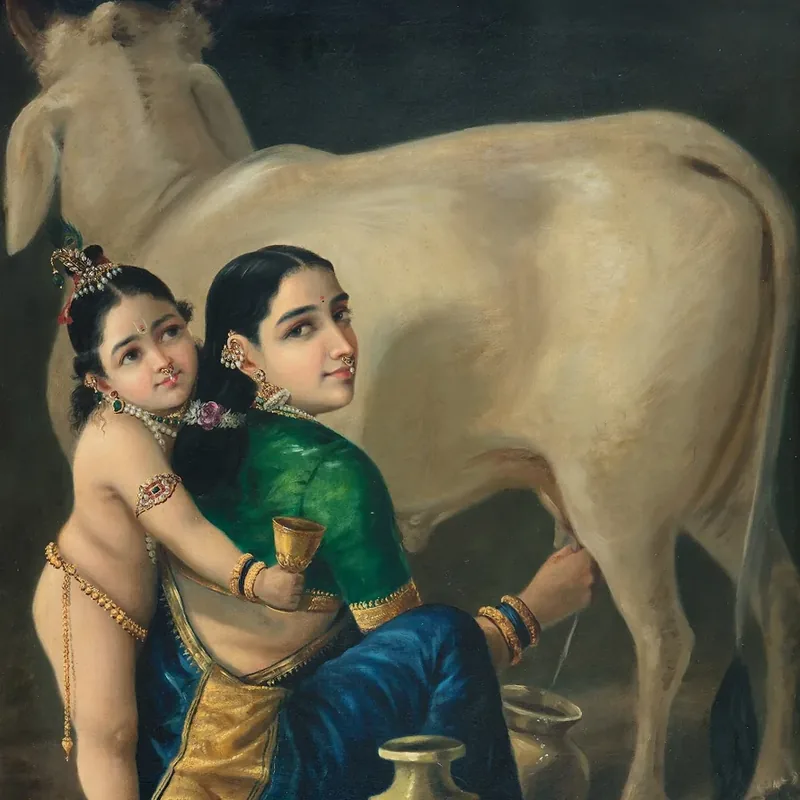
Krishna8th century
भज गोविन्दं
Bhaja Govindam (Moha Mudgara)
By Adi Shankaracharya · संस्कृत
॥ શ્રી કૃષ્ણાય નમઃ ॥
Shri Krishnaya Namah
भज गोविन्दं
Bhaja Govindam (Moha Mudgara)
By Adi Shankaracharya
संस्कृत · 8th century · Stotra
~1 min readKrishna bhakti
A bracing Sanskrit hymn by Adi Shankaracharya urging devotion over dry intellect. It strips away vanity, wealth and cleverness as things death will not spare. Also called Moha Mudgara — 'the hammer that shatters delusion'.
- Author
- Adi Shankaracharya
- Language
- संस्कृत
- Literary form
- Stotra
- Century
- 8th century
- Tradition
- Krishna bhakti
Voice Lab
Recite in My Voice
Record yourself reciting or singing this work once. Stored only on this device, never uploaded. The player will use your recording instead of the synthetic chant whenever you tap play.
भज गोविन्दं भज गोविन्दं, गोविन्दं भज मूढमते। सम्प्राप्ते सन्निहिते काले, न हि न हि रक्षति डुकृञ्करणे॥
मूढ जहीहि धनागमतृष्णां, कुरु सद्बुद्धिं मनसि वितृष्णाम्। यल्लभसे निजकर्मोपात्तं, वित्तं तेन विनोदय चित्तम्॥
दिनयामिन्यौ सायं प्रातः, शिशिरवसन्तौ पुनरायातः। कालः क्रीडति गच्छत्यायुः, तदपि न मुञ्चत्याशावायुः॥
Meaning
Worship Govinda, worship Govinda, worship Govinda, O fool! When the appointed hour of death draws near, no amount of grammar rules will save you. O deluded one, give up the thirst for wealth; cultivate a desireless mind. Be content with whatever comes through your own honest effort. Day and night, dusk and dawn, winter and spring come and go again — time plays on, life ebbs away, yet the gust of desire never leaves us.
Devotional companion
About
A bracing Sanskrit hymn by Adi Shankaracharya urging devotion over dry intellect. It strips away vanity, wealth and cleverness as things death will not spare. Also called Moha Mudgara — 'the hammer that shatters delusion'.
Meaning
Adi Shankara's stirring call to seek God over worldly attachment.
In depth
Worship Govinda, worship Govinda, worship Govinda, O fool! When the appointed hour of death draws near, no amount of grammar rules will save you. O deluded one, give up the thirst for wealth; cultivate a desireless mind. Be content with whatever comes through your own honest effort. Day and night, dusk and dawn, winter and spring come and go again — time plays on, life ebbs away, yet the gust of desire never leaves us.
History & context
Attributed to Adi Shankaracharya (8th century). Tradition tells of Shankara seeing an old scholar drilling grammar rules and singing this to remind him — and all of us — that learning without devotion is empty when life runs short.
Why people recite it
Recited as a reminder of priorities — sung in Advaita and Krishna circles alike, and turned to whenever one feels lost in striving, status or mere accumulation.
Life lessons
- Time is the one currency you cannot earn back. Spend it on what endures — love, character, the inner life — not on cleverness that the grave ignores.
Key themes
Bhaja GovindamShankaracharyaVedantaKrishnaVairagyaName ChantingMorning PrayerProtection
About the author
Adi Shankaracharya
आदि शङ्कराचार्यः
- Era
- c. 8th century CE (traditional)
- Region
- Kaladi, Kerala; travelled across India
- Tradition
- Advaita Vedanta
Adi Shankaracharya was a philosopher and teacher who systematised Advaita Vedanta, the non-dual understanding that the individual self and the ultimate reality are one. Traditionally said to have lived only thirty-two years, he travelled the length of India in debate and teaching, and is credited with establishing monastic centres in the four directions.
Alongside his commentaries on the Upanishads, Bhagavad Gita and Brahma Sutras, a large body of devotional hymns (stotras) is attributed to him — works of striking beauty that hold philosophical depth and heartfelt devotion together.
His exact dates are debated by scholars, and the authorship of several popular stotras is traditional attribution rather than settled fact.
Notable works
Bhaja GovindamVivekachudamaniSoundarya LahariNirvana Shatakam
His dates and the authorship of several hymns are traditional attribution, debated by scholars.
You may also like
Ashtakamसंस्कृत
Madhurashtakam
Vallabhacharya · 15th century
Eight verses on the sweetness of Krishna — where every line ends in 'madhuram', sweet.
Read & recite →
Stutiसंस्कृत
Achyutam Keshavam
Traditional · Traditional
I worship the Infallible One, Keshava, Rama, Narayana; Krishna the bound-bellied, Vasudeva, Hari; bearer of Lakshmi (Shridhara), Madhava, beloved of…
Read & recite →
Bhajanગુજરાતી
Vaishnava Jana To
Narsinh Mehta · 15th century
Gujarat's beloved definition of a true devotee: one who feels another's pain as their own.
Read & recite →
Bhajanहिन्दी
Shri Krishna Govind Hare Murari
Traditional · Traditional
Glory to Shri Krishna, Govind, Hari, Murari — slayer of Mura.
Read & recite →
Bhajanहिन्दी
Payoji Maine Ram Ratan Dhan Payo
Mirabai · 16th century
Mirabai's song of finding the priceless jewel of the Divine Name — a wealth no one can steal.
Read & recite →
Shlokaसंस्कृत
Bhagavad Gita 2.47
Vyasa (Bhagavad Gita) · Ancient
You have the right to action alone, never to its fruits.
Read & recite →
Source & trust
Public domain
- Attribution
- Adi Shankaracharya
- Language
- संस्कृत · 8th century
- Source
- Public domain — Adi Shankaracharya, 8th c.
- Text edition
- Public domain — Adi Shankaracharya (Moha Mudgara).
Devotional commentary and life lessons are editorial reflections. Historical details are limited to well-documented facts; devotional belief is labelled as tradition, never presented as proven history.